
 +86-0755-86131192
 2026-08-10
Personalized health management is gaining growing public acceptance, and the market keeps expanding. The traditional manual-measurement-based approach for custom insole production can no longer meet market demands.
An increasing number of merchants have adopted 3D foot scanners for insole customization to sharpen their market competitiveness.
What is a 3D foot scanner?
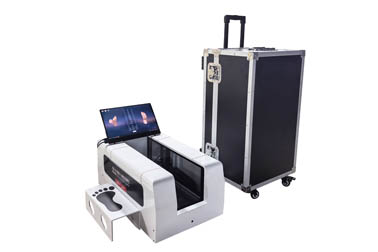
A 3D foot scanner is a device that adopts optical principles such as laser to capture three-dimensional foot data and generate visual measurement reports.
Measurable parameters include foot length, foot width, foot fat thin profile, arch length, arch height, heel margin length, metatarsophalangeal circumference, instep circumference, little toe angle, footprint index and more.
Measured results can be exported as measurement reports displayed in charts. With these reports, users can gain a full picture of their foot health conditions, such as flat feet, high arches, heel varus, heel valgus and hallux valgus. The reports also support toe type classification, shoe size suggestion and insole recommendation.
Besides, the collected data can be exported in 3D file formats including STL.
STL files allow designers to carry out insole modeling efficiently.
Designers import STL data directly into professional insole design software to reconstruct complete 3D foot models, which serves as the critical foundation for subsequent insole design.
Designers optimize insoles according to measurement reports. Adjustments cover arch support height, heel wrapping curvature, forefoot cushion thickness and stress-relief zones, so as to deliver better wearing comfort for end users.
For foot deformities such as flat feet, high arches, heel varus, heel valgus and hallux valgus, correction design needs to be combined with plantar pressure data. Such customized design helps relieve and even greatly improve these foot conditions. 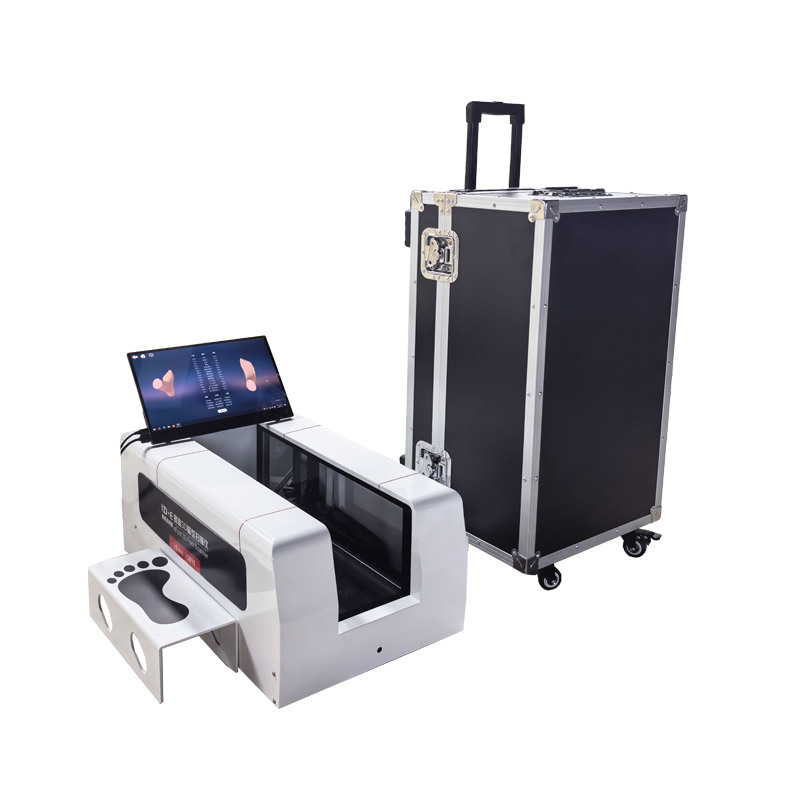
Advantages of applying 3D foot scanners to insole design and manufacturing:
1.High-precision data with accuracy within 0.5 mm, which cannot be achieved via manual measurement. Manual measurement often brings errors of 2-3 cm, and subjective mistakes may occur due to operator distraction.
2.Comprehensive data coverage. A 3D foot scanner captures over 60 key foot parameters and full-range morphological information of feet.
3.Fast measurement. Data acquisition for both feet normally takes roughly 20 seconds.
4.Direct software import capability. It greatly cuts down insole modeling and design cycles, improves overall efficiency and reduces labor costs. Customers can receive finished products sooner, bringing better user experience.
5.Non-contact measurement. Radiation-free and harmless to human bodies. The whole process is pain-free and non-invasive, suitable for all crowds including the elderly, children and people with sensitive skin.
6.Storable digital archives for repeated use. When users need new-style products later, existing data can be reused without repeated physical scanning.
 Back to list


 +86-0755-86131192