
 +86-0755-86131192
 2026-04-29
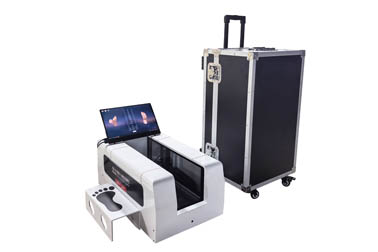
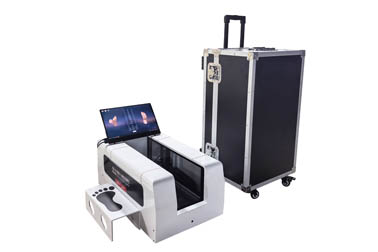
The plantar 3D laser scanner adopts the optical principle of laser to conduct all-round scanning and measurement of the foot from multiple perspectives. It has the advantages of high precision, no radiation and comprehensive data.
In terms of measuring flat feet, it has absolute advantages compared with the traditional visual inspection method and footprint method.
Then, how does the plantar 3D laser scanner measure flat feet?
1. Pre-measurement preparation.
Before measurement, the tester needs to take off socks and keep the sole of the foot clean and dry; otherwise, it will easily affect the scanning accuracy.
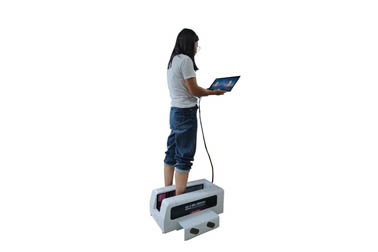
Stand with both feet on the scanning area of the device, roll up the trouser legs above the ankle and close to the knees finally. Because the general plantar 3D laser scanner is also equipped with a rear camera, which can measure data such as the heel angle.
When standing, keep both feet shoulder-width apart and the body in a naturally relaxed state, look straight ahead at the same time, and let the arms hang down naturally. In this way, the center of gravity can be evenly distributed, and the measured data will be more objective.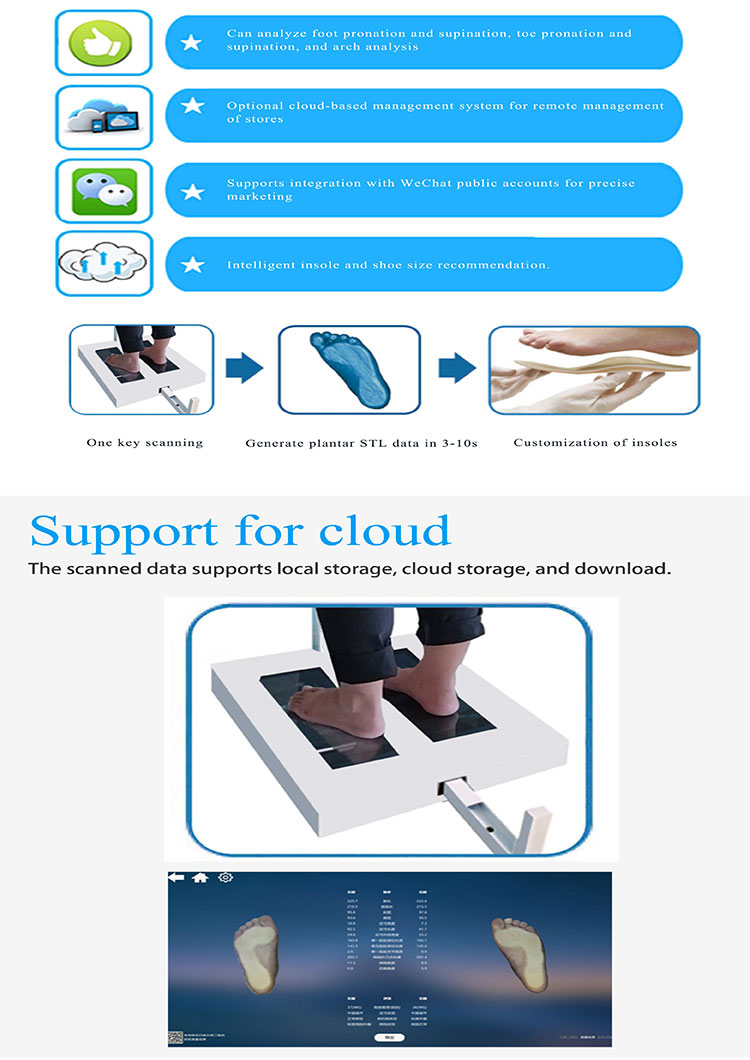
2. Conduct measurement.
During the measurement, the device performs high-speed scanning of the sole from multiple angles through laser linear array, white light scanning and other technologies, including all-round measurement of capturing the plantar curved surface, arch height, heel width and length, heel shape and so on. Then the software automatically splices multi-frame point data, and finally generates a plantar 3D model that completely fits the plantar size.
The 3D model data can fully present the typical characteristics of flat feet such as medial arch collapse and heel valgus. On the software, the 3D model can be flipped and scaled, which is convenient for us to observe the foot from multiple angles.
In addition, it will generate 3D data in STL and other formats as well as chart-based measurement reports.
The entire measurement process can often be completed in about 20 seconds, with high precision, fast scanning speed and no radiation.
3. Quantitative standards for flat feet.
(1) Arch Index (AI).
The Arch Index (AI) is the currently internationally accepted core indicator.
In the software, our sole is divided into three areas: forefoot, midfoot and hindfoot (excluding toes).
AI value = Midfoot contact area ÷ Total plantar area.
If the AI value is between 0.21-0.26, it indicates a normal foot.
If the AI value is between 0.26-0.28, it indicates mild flat foot.
If the AI value is between 0.28-0.30, it indicates moderate flat foot.
If the AI value is greater than 0.30, it indicates severe flat foot.
(2) Medial Longitudinal Arch.
The medial longitudinal arch is the most critical and highest arch of the sole. It is longitudinally distributed along the medial side of the foot and composed of calcaneus, talus, navicular bone, medial cuneiform bone and first metatarsal bone.
The medial longitudinal arch angle is an included angle formed by connecting three marked points in the 3D model: the lowest point of calcaneus, talar head and first metatarsal head. The normal arch angle is generally 113°-130°. For flat feet, the angle is greater than 130°, and the larger the angle, the more serious the collapse.
(3) Arch Height.
Arch height refers to the vertical height from the highest point of the arch to the ground.
For normal feet, the arch height is generally 1-2cm.
If the arch height is less than 1cm or even the arch disappears, it means flat foot.
The above are the currently popular parameters for judging flat feet. Judgment based on the Arch Index (AI) is more common, and most foot scanner devices are evaluated based on this principle.
 Back to list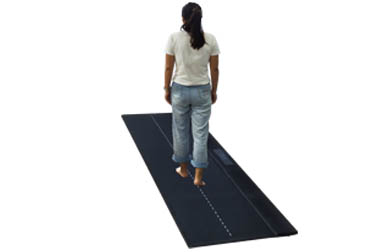


 +86-0755-86131192