
 +86-0755-86131192
 2026-10-19
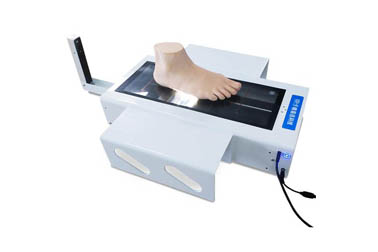
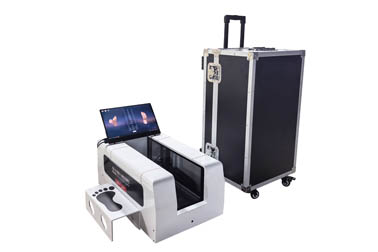
The plantar 3D scanner is a device that uses optical principles such as laser to collect three-dimensional data of the human foot and generate visual measurement reports.
Traditional measurement methods mainly rely on rulers, footprint boards, foam boxes, plaster casts or technicians’ tactile judgment for detection and measurement. They carry strong subjectivity and provide only a limited number of data dimensions.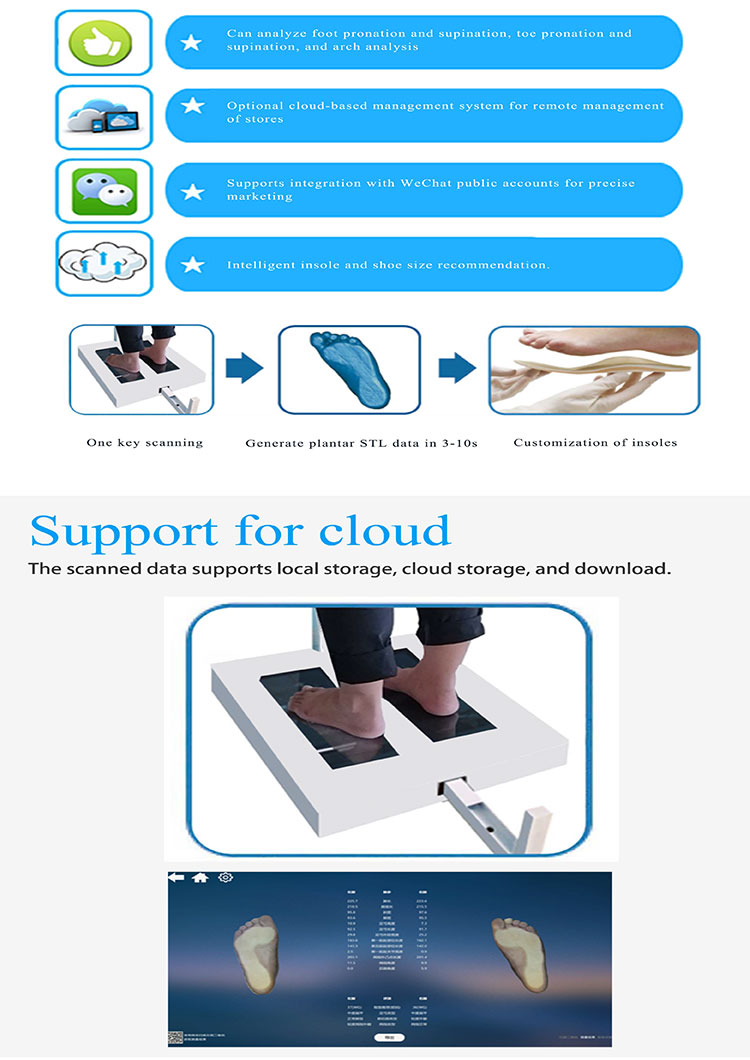
The main differences between the plantar 3D scanner and traditional manual foot measurement are as follows:
A. Different data dimensions.
Traditional manual foot measurement can usually only measure a small number of dimensions such as foot length and foot width.
In contrast, the plantar 3D scanner can output 20 to 60 key dimensional data items of the sole.
B. Different precision and stability.
Traditional manual measurement is largely affected by technicians’ experience, tools and body postures, resulting in large precision errors. The error may reach 3–5 mm or even higher in some cases.
By contrast, measurements taken by the plantar 3D scanner achieve an error within 0.5 mm, delivering more accurate data. This is especially critical for making custom insoles and custom shoes, which have stricter data requirements.
C. Different measurement speeds.
Traditional manual measurement involves time-consuming procedures such as plaster casting and foam impression taking. It takes at least several minutes and may require more than half an hour.
In contrast, the plantar 3D scanner can capture complete data in only 10 to 20 seconds and directly generate a measurement report.
D. Different user experience.
Traditional manual measurement may cause contact, compression and material residue. The plantar 3D scanner adopts non-contact measurement, which is more hygienic and more suitable for children, the elderly, diabetic patients and other groups.
E. Different subsequent applications of data formats.
Traditional measurement produces simple data formats and cannot be directly connected to digital production.
In contrast, the plantar 3D scanner can acquire 3D data files such as STL, which can be directly connected to CAD, CAM and 3D printing for personalized and corrective design and fabrication.
Moreover, after plantar 3D scanning, a visual plantar assessment report can also be generated. It helps us evaluate and judge flat feet, high arches, heel varus, heel valgus and other foot conditions.
 Back to list


 +86-0755-86131192