
 +86-0755-86131192
 2026-08-31
Severe cases of flat feet or high-arched feet can directly affect people’s daily lives. Symptoms such as plantar pain may occur after prolonged standing or long-distance walking.
Traditional assessment methods for flat feet and high-arched feet mainly include the following approaches:
1.Wet footprint test
This method is quite simple. Wet your foot and step onto a dry flat surface or a sheet of paper. The footprint left behind is then examined to identify flat feet or high-arched feet.
A normal footprint features a clear indentation on the inner side of the foot arch.
If the inner indentation disappears and the footprint forms an almost full continuous wide band, the foot is identified as a flat foot.
If the inner indentation is extremely large and the mid-foot section is partially or completely disconnected in the footprint, the foot is judged to have a high arch.
2.Empirical visual assessment
Some experienced doctors make diagnoses of flat feet or high-arched feet through visual observation built on clinical experience.
They mainly check the arch shape under weight-bearing and non-weight-bearing conditions respectively.
In a standing weight-bearing position, the examiner observes from the medial side of the foot whether the arch collapses and touches the ground. Obvious collapse indicates flat feet.
Under non-weight-bearing conditions, for instance when the patient lifts the foot while sitting, a recoverable arch suggests flexible flat feet. If the arch fails to spring back in this posture, the condition is defined as rigid flat feet.
There are other assessment techniques as well. Nevertheless, most of these traditional methods lack precise numerical criteria and rely heavily on subjective experience. Misdiagnosis is likely to happen, and it is difficult to clearly grade the condition into mild, moderate and severe flat feet or high-arched feet. Evaluation results carry a certain degree of subjectivity.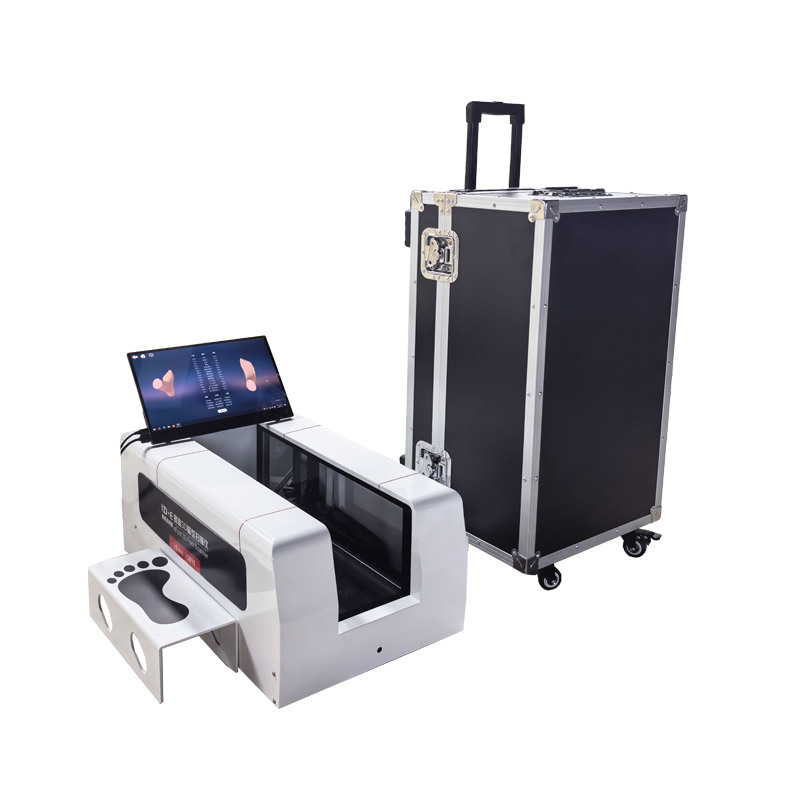
With the adoption of 3D foot scanners, flat feet and high-arched feet can be evaluated more precisely with quantifiable objective data.
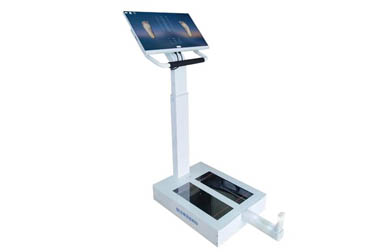
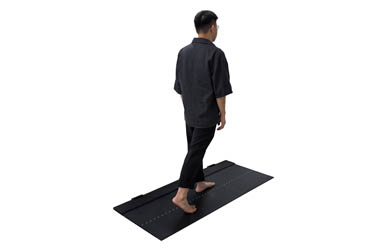
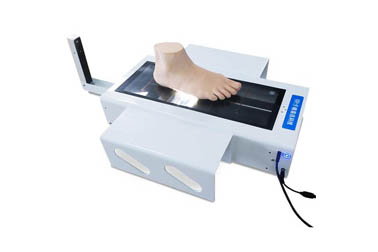
Working on optical principles such as laser scanning, a 3D foot scanner captures three dimensional morphological data of the human foot. It finally exports 3D files in formats like STL and printable measurement reports in PDF format.
The 3D foot scanner delivers objective evaluation mainly by calculating the Arch Index (AI).
Arch Index = Contact area of the middle one-third segment of the plantar surface ÷ Total plantar area excluding the toes
An AI value below 0.21 indicates a high-arched foot with a very small mid-foot contact area.
An AI value ranging from 0.21 to 0.26 corresponds to a normal foot arch.
An AI value between 0.26 and 0.28 refers to mild flat feet.
An AI value between 0.28 and 0.30 represents moderate flat feet.
An AI value greater than 0.30 stands for severe flat feet, where the arch almost fully touches the ground and the mid-foot contact area is considerably large.
The 3D foot scanner provides objective data support for judging flat feet and high-arched feet and delivers more reliable assessment outcomes. Besides, the scanning process only takes roughly 10 to 20 seconds, offering high efficiency and high diagnostic accuracy.
 Back to list


 +86-0755-86131192